Parameters, Weights, and GPUs: What's Inside an AI Model
GPT-4 has roughly 1 trillion adjustable numbers inside it. Your brain has about 100 trillion synapses. Both "learn" by changing how strongly different connections fire.
That's not a coincidence. And understanding what those numbers are — and why they need special hardware to run — will change how you think about choosing AI tools.
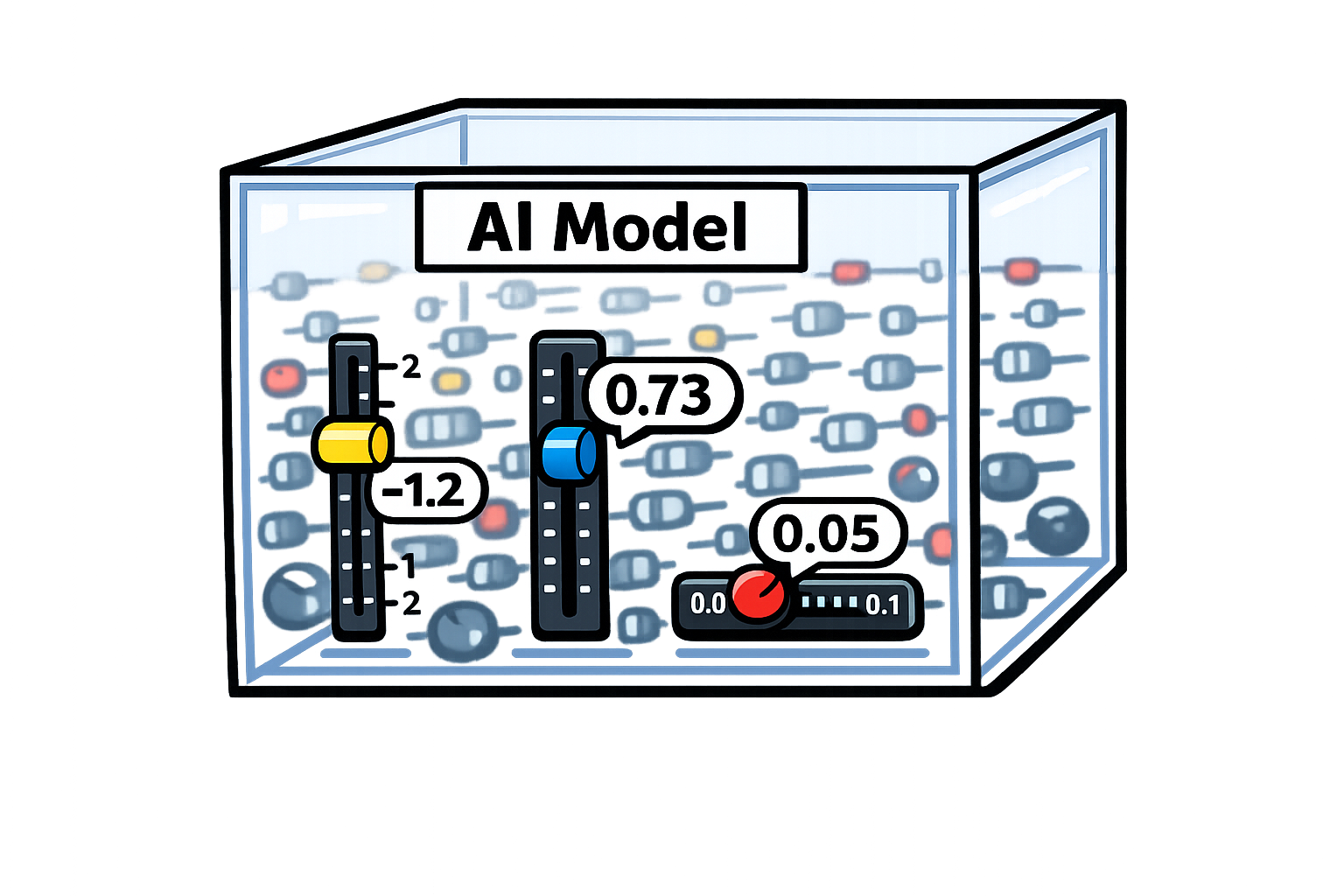
What's Inside a Model
When someone says "GPT-4 has 1 trillion parameters," they mean there are 1 trillion adjustable numbers inside the model. That's it. No magic. Just numbers.
Parameters are like dials on an enormous mixing board — not 10 or 100 dials, but billions. During training, the system slowly turns each dial until the output sounds right. Once training is done, every dial is locked in place.
Weights are the exact positions those dials are set to. A weight of 0.73 might strengthen one pattern. A weight of -1.2 might suppress another. Together, billions of weights determine how the model responds to any input.
Here's the important part: the training data is gone after training. The model didn't memorize your data. What's left — frozen in place — are just the weights. The model is nothing but numbers now.
What's the difference between a parameter and a weight? A parameter is the dial. A weight is the position the dial is set to. In practice, people use the terms interchangeably — and that's fine. Just know that "175 billion parameters" means "175 billion numbers that were adjusted during training."
Does Size Actually Matter?
Here's the counterintuitive part: a 7 billion parameter model can beat a 70 billion parameter model on your specific task.
Generally, bigger models are more capable. Doubling the parameters usually improves accuracy, reasoning, and versatility. But the improvement plateaus — a 100B model isn't twice as smart as a 50B model.
And in 2026, a major shift is happening: smaller, fine-tuned models often outperform larger general-purpose models on specific tasks.
Think of it like a generalist doctor vs. a cardiologist. The GP knows more overall, but for heart conditions, the cardiologist wins every time. A 7B model fine-tuned on legal contracts will outperform a 70B general model for legal contract work — while being cheaper and faster.
| Size | Parameters | Use Case |
|---|---|---|
| Small | 1–7B | Mobile apps, edge devices, fast responses |
| Medium | 8–20B | Enterprise tasks, balanced speed/quality |
| Large | 50–200B | Complex reasoning, multi-domain tasks |
| Very large | 200B+ | Frontier research, most capable models |
The "best" AI for your company probably isn't the biggest. It's the right-sized model for your task. A fine-tuned 7B model can be cheaper, faster, and more accurate than a general 70B model — if it's optimized for what you need.
Why AI Needs GPUs
Think about the last time a webpage loaded slowly. Now imagine waiting 45 minutes for an AI to respond to a single prompt. That's what happens if you try to run AI on a regular CPU.
A CPU (your computer's normal processor) is like one cashier processing every customer one at a time. It's great at complex, sequential tasks — but AI needs billions of simple calculations done simultaneously.
A GPU is like 1,000 cashiers all working at the same time. Each one handles a different calculation in parallel. AI models need massive matrix multiplications at every step — exactly the kind of repetitive, parallel math GPUs were built for.
Here's the fun twist: GPUs weren't designed for AI. They were designed for video games — rendering millions of pixels on screen simultaneously. AI researchers realized in the early 2010s that the same chip architecture was perfect for neural network math.
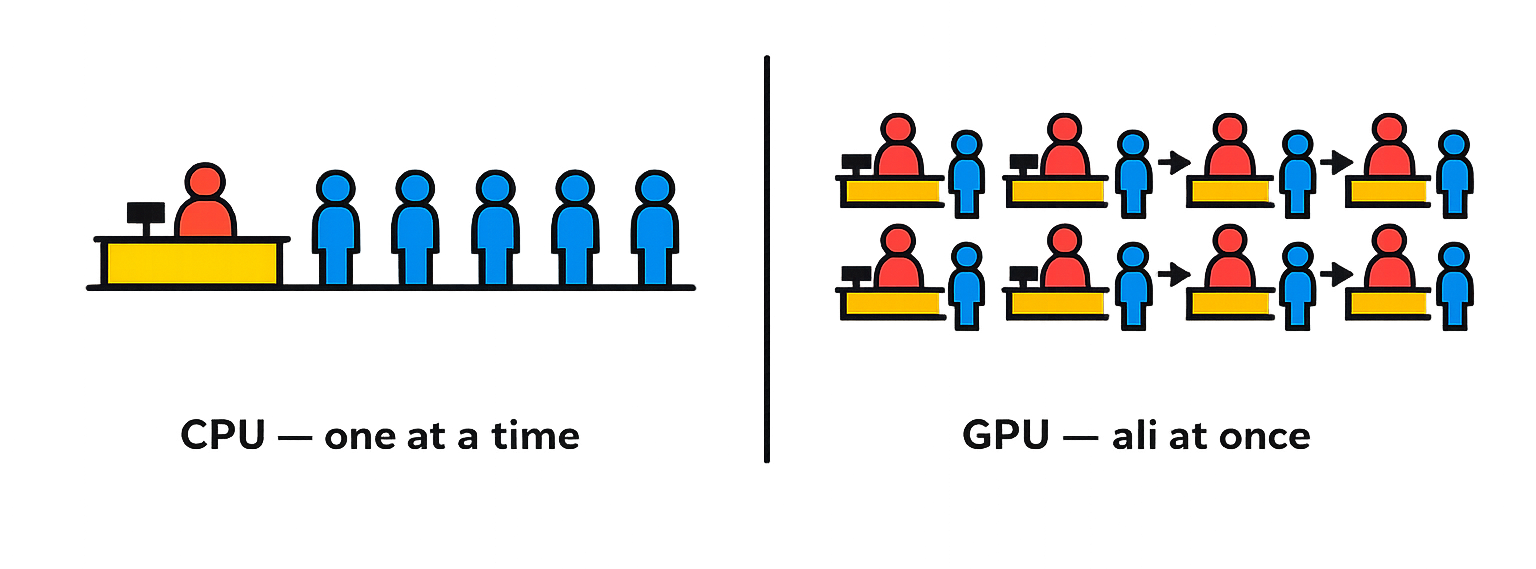
Why can't a regular CPU handle AI workloads at the same speed? Because a CPU processes tasks one at a time (or a handful at most). A GPU has thousands of smaller cores running in parallel. AI's billions of matrix multiplications are perfectly suited for this parallel architecture.
VRAM: The Hard Wall
Here's the constraint nobody mentions when they talk about model size: GPU memory (VRAM).
Running a 70 billion parameter model requires roughly 140GB of GPU memory. A single top-of-the-line NVIDIA A100 has 40–80GB. You'd need at least two — and each costs $10,000–$30,000.
Think of VRAM as a desk. You can only work with what fits on the desk right now — even if you have a huge filing cabinet for storage. A bigger model needs a bigger desk. If the model doesn't fit, it simply won't run.
This is why "what model can I run?" is always a VRAM question first. And it's why cloud API access exists — paying per use is far cheaper than buying the hardware yourself for most businesses.
| Model Size | VRAM Needed | Hardware Required |
|---|---|---|
| 7B | ~14GB | Single consumer GPU |
| 13B | ~26GB | High-end consumer GPU |
| 70B | ~140GB | 2-4 data center GPUs |
| 200B+ | ~400GB+ | Multiple enterprise GPUs |
NVIDIA dominates AI hardware because their CUDA software ecosystem is the industry standard. The main chips you'll hear about: A100, H100, and the newer H200 — each designed for AI workloads at different scales.
Next time someone mentions a model size (like "we're using a 7B model" or "GPT-4 has a trillion parameters"), you now know what that means: the number of adjustable numbers inside, the hardware needed to run it, and the cost tradeoff between size and speed.
Now you know what's inside an AI model and what hardware runs it. But there's another hard limit that shapes every conversation you have with AI — one that has nothing to do with hardware. It's about how much text AI can "see" at once.
Next up: Context Window, Memory, and Performance — why AI forgets everything between conversations, and what you can do about it.
Good Read
- What are Model Parameters? — IBM
- Why GPUs Are Great for AI — NVIDIA
- What is a GPU & Its Importance for AI — Google Cloud
- AI Model Parameters Explained: 2B vs 7B vs 40B — Travis Media